


Please read the Thornhill PS Start Up package below, as it contains very important information about our school procedures and policies.
To complete the forms, please use the Family Dashboard and visit https://startupforms.yrdsb.ca/
If you prefer to download a copy of the form and return a hard copy to school, you can find a link to each form at the bottom of this page.
THORNHILL PUBLIC SCHOOL
This welcome package includes important information about our school and the school year. It is important that families review this document.
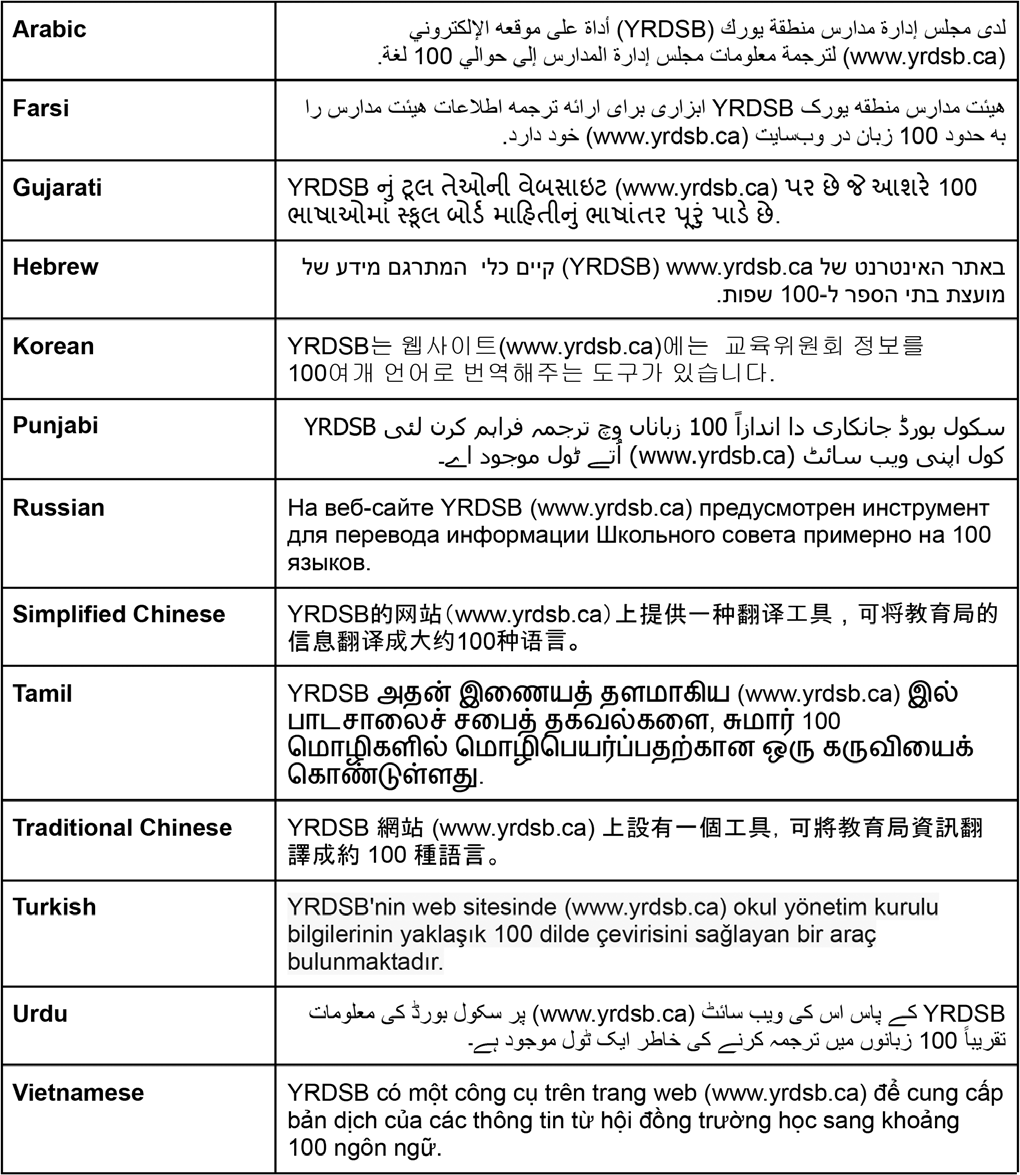 |
The YRDSB has a tool on its website (www.yrdsb.ca) to provide translation of school board information in about 100 languages.
Information Package and Form Checklist
This package includes important information about the school. Please review this information. You will also receive an email in the coming weeks with forms that you need to complete for each child. If you prefer to receive a paper copy or have not received the forms, please contact your school office.
Return the completed forms by September 18th, 2026.
Required Forms
These forms will be sent by email and must be completed.
School Start-Up Permissions Form
- Student Information Consent Form
Additional Forms
These programs or opportunities are optional. These forms will be sent by email and must be completed only if you or your child wish to participate.
- Request for Faith Accommodations Form
- School Council Nomination Form
Welcome From the Principal
Dear Families,
Welcome to all our new and returning families. I hope you all had a safe, healthy, and enjoyable summer. Our school team has been working hard to prepare to welcome your children back to school.
We have a dedicated staff with a strong commitment to student learning, achievement, and well-being. We are committed to supporting our students’ transition back to school and to providing a learning environment where everyone feels safe, valued, welcome and respected.
There are some important things we want to share at the start of the school year:
- This welcome package includes important information about our school. Please take time to review it carefully.
- The Guide to the School Year includes important information you may need throughout the year. Translation tools are available on the website. You can find the guide under the Family Resources on the school and board website homepage.
- Each year we ask families to complete important back-to-school forms. You will receive an email in the coming weeks with a link to the online forms. If you prefer to complete a paper copy, please contact the main office.
- Access the Family Dashboard at family.yrdsb.ca for one-stop access to applications.
There are a few upcoming dates I would like to highlight, including:
- Curriculum Information Night – Thursday, September 17, 2026.
- First School Council Meeting – Thursday, September 24th, 2026.
We value the relationship and partnership we have with families and look forward to speaking and working with you in the months ahead. Please do not hesitate to contact the school if you have any questions. We welcome the opportunity to connect with you. There are many ways to stay connected with what’s happening in our school:
- Visit our school website for up-to-date information about events.
- You can also find school board updates at www.yrdsb.ca, Instagram @yrdsb.schools, or by listening to the TuneIn YRDSB podcast.
I wish you all a happy, safe and successful school year.
Sincerely,
Lisa Hascal
Principal
Contact Information
For Ministry and Board compliance purposes, please ensure that the school has your up-to-date contact and emergency information. Please contact your school’s main office to review or update your information, including:
- address, work or home numbers or other contact information
- emergency contacts and telephone numbers
- changes in custody agreements
- medical alert or changes in health condition (e.g., allergies, medications)
- Vehicles dropping students off are to pull up to the middle lane of the loop.
- When unloading, students are to only get out when their car is the first car in the line-up *a staff member will be there to watch them as they safely exit the vehicle.
- Parents are not to park their car in the Kiss-N-Ride and get out of their cars. Vehicles cannot be left unattended.
- Students are to be ready to get out when their car is the first car in the line-up in order to be able to move cars through as quickly and safely as possible.
If your child has a medical condition that requires emergency intervention, an essential routine health care plan, or any of the following medical conditions: Anaphylaxis, Asthma, Diabetes or Epilepsy/Seizure Disorder you must contact the school to ensure information is current and accurate.
Our School
Regular supervision begins at 8:15 am and students are not to enter the school before this time. The bell rings at 8:30 a.m., signaling students to be ready in their classrooms. Classroom attendance is taken immediately following the bell and students arriving in class after this time are considered late. Students who late will need to report to the office so their attendance is changed from absent to late before going to class.
Kiss-N-Ride Procedures:
For all parents/guardians accessing our Kiss-N-Ride, please ensure that you review our drop off and pick- up procedures, which have been implemented in order to increase efficiency and to ensure the safety of all.
Drop-Off:
Students are to enter the school by grades:
- Kindergarten – congregate in the kindergarten corral and enter the doors located in the corral(south side of school)
- Grades 1 to 3 – congregate on the tarmac and enter the school from the primary door (south-west)
- Grades 4 to 8 – congregate on the tarmac and enter the school from the junior/intermediate door (south-east)
Pick-Up/Dismissal:
As has been past practice, during pick up time, parents/guardians are asked not to enter the bus loop/Kiss-N-Ride. Vehicles are asked to park alongside Arnold Avenue and to have your child/children meet you in a designated spot (or park and meet them on the tarmac). This will ensure the safe loading of our students onto the bus. For student safety, we do not want students walking through the parking lot or bus loop to meet their parents. Remember, the bus loop is for buses and emergency vehicles only, so please do not enter the bus loop or block the entrance or exit off of Arnold Avenue.
We thank you for your continued support in keeping our students and staff safe. Students are dismissed promptly at 2:50 p.m. from the school at which time parents are responsible for their children.
School Day Organization
Office hours: 8:00 a.m.-3:30 p.m.
Period | Times |
|---|---|
| Before school supervision | 8:15-8:30 am |
| Period 1 | 8:30-9:30 |
| Period 2 | 9:30-10:10 |
| Recess | 10:10-10:30 |
| Period 3 | 10:30-11:30 |
| Period 4 | 11:30-12:10 pm |
| Lunch | 12:10-1:10 pm |
| Period 5 | 1:10 - 2:10 pm |
| Period 5 | 2:10 – 2:50 pm |
| Dismissal | 2:50 pm |
Additional Information
Please note, the information in this School Welcome package is subject to change based on updates or legislative changes.
More information is available in the Guide to the School Year on the school and board website under Family Resources.
Attendance
Regular and punctual attendance affects school success and is expected of students.
Late Arrivals
If a student arrives at school after the entry bell (in the morning or after lunch), they are considered late and must check in with the office.
Reporting Attendance
Please inform the school if your child is going to be absent or late to school before 8:30 a.m. Where possible, notify the school in advance by using Edsby or calling the school office. You can also access student attendance reporting through the Family Dashboard at family.yrdsb.ca.
Parents/guardians may select “Mental Health” as the reason for an absence, in accordance with the Ministry of Education Policy/Program Memorandum 169.
Safe Arrival And Departure Program
The safety of our students is a priority. Our safe arrivals and departures protocols help us account for absent students. Please provide the school with complete and current emergency contact information.
If you have not informed the school of your child’s absence in advance, the school will take the following steps to ensure your child is safe:
- We will call your home.
- If we do not reach you at home, we will call your work and/or cell phone.
- If we cannot reach you at work, we will call your emergency contact number.
- If we cannot get information from your emergency contact about your child’s location, we will speak to a sibling if one is in the school.
- If we are still unable to get information, we may check with a friend of your child and other staff.
- If all contact and emergency numbers have been tried and a student is still deemed to be absent without explanation, we will contact York Regional Police (YRP) immediately.
Arrivals and Departures
Families who live within walking distance are encouraged to use active school travel, including walking or rolling (cycling, scootering, skateboarding). Active travel supports student physical and mental health and readiness to learn, reduces traffic, protects the environment and helps make school zones safer for everyone.
School Bus/Taxi
For students who are eligible to take the school bus, bus routes and times can be found at net.schoolbuscity.com.
For students who are eligible to take the school bus, please keep in mind that students are only permitted to ride on the bus to which they are assigned and must get on and off their designated stops. Riding the bus is a privilege that can be revoked if students do not follow the drivers’ instructions. Parents/guardians of students who are eligible to receive school bus transportation per the Board’s Transportation Policy should:
- Understand the need to make alternative arrangements for their child/children if the school bus is late.
- Refer to the Late Bus Report on the Student Transportation Services website at www.schoolbuscity.com before leaving for the bus stop in the mornings and afternoons.
- Ensure their child(ren) arrive at the bus stop five minutes before the regularly scheduled pick-up and drop-off times (10 minutes during the first week of school).
- Ensure their child/children's safety and conduct while walking to, from and waiting at a designated bus stop.
- Make alternate arrangements for their children if they are unable to meet them at a bus stop. To help ensure student safety, Student Transportation Services recommends students in Kindergarten and Grade 1 are met at their bus stop by a parent/guardian, and age appropriate arrangements made for all other grades.
- Know their child(ren)’s route number.
- Know their child(ren)’s bus stop location.
- Know the school and bus company phone number in the event of an emergency.
More information about bus routes and times can be found at www.schoolbuscity.com.
School Bus Safety
When riding school buses, students must:
- Be at the bus stop five minutes before the scheduled pick up.
- Keep well away from the road until the bus has stopped and do not move toward the bus until it has stopped.
- Watch for the bus driver’s signal before crossing the road and look both ways and then cross the road.
- Get on the bus safely by using the handrail and go directly to a seat.
- Stay seated while the bus is in motion.
- Not eat or drink on the bus.
- Keep the aisle clear of books, knapsacks, lunch bags and other items.
- Keep windows closed.
- Never throw anything inside the bus or out of the window.
- Talk quietly and so as not to distract the driver.
- Use respectful language.
All school rules apply to students riding school board vehicles.
Cycling or Rolling to School
Students who use bicycles, rollerblades, skateboards or non-motorized scooters to travel to school:
- Must wear a helmet.
- Must walk while on school property.
- Should lock bicycles on the bike rack, and store rollerblades, skateboards or non-motorized scooters in their locker, backpack or school designated area; the school is not responsible for any lost or damaged personal items.
Driving to School
Parents/guardians who choose to drive their children to school are asked to consider parking a block or two away from the school and walking the rest of the way. In the morning, vehicles are not to park or idle in the Kiss N Ride as it is to be used for only stopping long enough to allow students to disembark. If you need to exit your vehicle, please park along Arnold Avenue. This will allow the “Kiss and Ride” lane to flow. Choosing active travel can improve physical and mental health and helps students start the day alert and ready to learn. It also helps to protect the environment and reduce traffic, making school zones safer for everyone. Please be considerate and careful when driving to our school. Please work with us to keep our students safe.
Weather Conditions
Transportation will be cancelled by 6:00 am if conditions are unsafe or are expected to deteriorate significantly by the time students are going home. Schools will remain open unless otherwise stated. For more information, visit the Student Transportation section of the board website.
To find out if transportation is cancelled, check: the @yrdsb.schools Instagram account, the YRDSB and school websites, the Student Transportation Services’ (STS) website at net.schoolbuscity.com or hotline 1-877-330-3001, and local media outlets.
There may be rare occasions when unprecedented winter weather events occur and we need to close all schools and board locations. For more information, please see the Severe Weather policy and procedures. At all times, students and families should be aware of somewhere else they can go or someone to contact if bus services are cancelled or delayed, or if schools are forced to close due to an emergency.
Before/After School Supervision
The safety of our students is our mutual priority and responsibility. Supervision for students in the morning begins 15 minutes before the bell. Parents/guardians are responsible for their children until staff are on duty. At the end of the school day, staff will supervise students’ safe exit from the school upon dismissal.
Academic Honesty
Students are expected to provide original evidence of their learning and appropriately acknowledge the work of others. Plagiarism refers to submitting work prepared, in whole or in part, by another person or source (i.e. artificial intelligence) and representing that work as one’s own. Please see the Equitable Assessment, Evaluation and Communication of Student Learning and Achievement policy for more information.
Accessibility
The board is committed to providing accessible programs, services and environment in line with Accessibility for Ontarians with Disabilities Act (AODA) and Policy 407: Accessibility. If you need assistance accessing board services, speak to staff in the school about how they can help or support you. If you require any information or materials on the board website in an alternative format, please contact Corporate Communications at communications@yrdsb.ca.
Accident Insurance
YRDSB does not provide individual student accident insurance coverage for student injuries that occur on school premises or during school-sponsored/extracurricular activities (athletics, clubs, field trips). We encourage families to verify that their child is covered under their insurance. If not, we recommend that you purchase student accident insurance. Student accident insurance provides coverage for injuries due to accidents not covered by government or private health plans (e.g. the cost of dental work). If your child is involved in an accident, whether at school or during non-school hours, insuremykids® protects your family from the resulting expenses. For more information, visit insuremykids.com or call 1-800-463-5437.
Allergies/Medical Conditions
There are students and staff in our school who have life-threatening allergies to nuts and other allergens. If they smell or come into contact with these allergens, they may have an anaphylactic reaction. To help create an allergen-safe environment, please refrain from bringing nuts or nut products to school as well as using scented products. For more information on how to help create an allergen-safe environment, please see information on allergies on the board website.
If your child has a serious or life-threatening allergy or prevalent medical condition, such as Anaphylaxis, Asthma, Diabetes or Epilepsy/Seizure Disorder, please let the school administration know immediately and speak to the school office staff about completing the appropriate health care plans. For more information, please see the Student Health Supports policy and procedures.
Caring and Safe Schools
Every student has a right to learn in a caring, safe and inclusive environment. We ask students and families to review our Caring and Safe Schools policy and procedures, which address a number of topics including:
- student progressive discipline
- bullying prevention and intervention
- student suspensions and expulsions
Students will review this important information during the Caring and Safe Schools start-up and mid-year presentations.
To support caring, safe, and inclusive school environments, positive student behaviour is reinforced, and inappropriate behaviour is addressed through a bias‑aware, progressive discipline approach that considers all relevant mitigating factors.
We use a bias-aware progressive discipline approach when inappropriate behaviour occurs. This means we consider a range of options to determine the most appropriate response to each situation to help students learn from their choices. In some cases, suspension or expulsion may be necessary. The Ontario Education Act and our board’s Caring and Safe Schools Policy outline the situations in which suspension and expulsion must be considered. When inappropriate behaviour occurs, information will be shared with the victim(s) and their families to the extent that legislation allows.
Report IT
YRDSB’s online Report IT button lets you share information about inappropriate student behaviour or incidents of hate or discrimination. It is available on the board and school website.
Code of Conduct
YRDSB’s Code of Conduct sets standards of behaviour for students and members of the school community that support a caring, safe and inclusive school environment. All school members must respect and treat others fairly, regardless of race, ancestry, place of origin, colour, ethnic origin, creed, sex, gender identity, gender expression, sexual orientation, age, marital status, family status or disability.
The Code of Conduct applies to all members of the school community including students, parents or guardians, school bus drivers, volunteers, school staff and community groups whether they are on YRDSB property, in a virtual learning environment, on school buses, at school-authorized events or activities, in before-and after-school programs including co-curricular activities and field trips, and may be applied to any other circumstances connected to the school that may have an impact on the school climate.
The Code of Conduct is part of the Caring and Safe Schools Policy.
Class Placements
Due to late registrations and enrolments over the summer, there may be staffing changes and class reorganization during the first few weeks of school. We do our best to keep these changes to a minimum and to support students during any transitions.
Communication between School and Home
Parents/guardians are our most important partners in educating children. We communicate with you in a variety of ways throughout the year. You are also encouraged to communicate with your child’s teacher. Speak with the teacher about what method of communication is preferred. You are welcome to request an interpreter to assist with some communication with your child’s school, such as interviews and meetings.
Canada’s Anti-Spam Legislation (CASL)
Canada’s Anti-Spam Legislation (CASL) requires organizations to obtain consent to send electronic messages that are commercial in nature. To that end, the YRDSB and school requires your consent to send any electronic messages that contain advertising or promotions, such as school fundraisers, lunch programs, field trips, the sale of yearbooks, prom or dance tickets, athletic events with an entry fee, or similar events and offers. To subscribe or unsubscribe to commercial electronic messages, visit the Family Resources page at www2.yrdsb.ca/family-resources or click on Manage Commercial Email Subscription in the Family Dashboard (family.yrdsb.ca).
Email/Electronic Communication
To improve communication between home and school and reduce paper use, we coordinate an email distribution list. The list will be maintained and used only by school staff to communicate electronically to parents/guardians. Your email will not be sold, distributed, or publicly posted. Families may receive electronic communication from the school through different platforms, such as Edsby or iNFORM.
Edsby
YRDSB has partnered with Edsby to provide a secure platform for families to connect with what’s happening at school and with your child’s education. Some of the features include:
- on-line student absence reporting
- appointment bookings for parent-teacher interviews/student-led conferences
- program registration
To set up your Edsby account please contact the school and request they issue an invitation to your email address. Instructions for setting up your Edsby account for the first time and answers to frequently asked questions are posted on the school website.
iNFORM
iNFORM is an automated telephone attendance reporting system used to:
- track incoming calls reported to the school by parents/guardians
- make outgoing calls to parents to verify student attendance
- Send out mass email communications to parent community
The school uses this distribution list to send a weekly communication to parents, including important information and updates from the school. Please ensure that your school has the correct phone number on file as the system uses the phone numbers parents have provided to the office to verify the caller.
Texts
Families can now receive text messages in emergency situations only - as part of our elementary school safe arrivals program or in the rare occasion of schools being closed due to emergency winter weather. Ensure your school has your correct cell phone number captured to participate. Families can opt out at any time.
School Cash Online
School Cash Online is an easy to use and safe way to pay for your children’s school fees. Parents can make secure online payments by credit card or Interac for their child’s yearbook, class trips, etc. Obtain your children's York Region District School Board student number from the school office and follow the steps in our FAQ: https://thornhill-ps.yrdsb.ca/about-us
Family Dashboard
The YRDSB Family Dashboard will give you secure one-stop access to information and applications related to your child’s education. It is designed to make it easier for families to engage with their child’s education.
Access the Family Dashboard at family.yrdsb.ca. If you do not have a Family Dashboard account, you can create one at any time by visiting family.yrdsb.ca, clicking on “No account?” and “Create one.” Detailed instructions and frequently asked questions are available at www2.yrdsb.ca/family-dashboard.
Stay Connected Online
You can also stay connected online through our school website, Instagram @yrdsb.schools and the Edsby app or website (https://yrdsb.edsby.com/). Some classrooms also have Google Classrooms, Twitter feeds or newsletters to help you stay connected. Your child’s teacher will provide more information about any communications tools they are using.
In addition, you can follow board news and updates through:
- Board website at www.yrdsb.ca
- Social media: Threads and Instagram @yrdsb.schools
- YouTube channel YRDSBMedia
- TuneIn YRDSB, the board’s podcast
Dress Code
For more information, see the Student Dress Code Policy and Procedure.
Emergency Preparedness
The board has a number of policies and procedures in place to address emergency situations if normal school operations cannot continue or where student and staff safety may be at risk. This could include a fire, flood or acts of violence. Schools have individual plans and conduct drills throughout the year. There will be six fire, one hold and secure, one bomb threat and two lockdown drills annually so students become familiar with emergency preparedness procedures. These drills are important so that in the case of an actual emergency, students and staff know what to do to be safe.
Excursions/Community Walks
Community excursions take place off school property, last less than one day and do not require transportation. Parents/guardians are asked to provide permission for community walks in the school start-up forms. Playing and learning outdoors supports student learning and well-being. Opportunities for students to build connections to the outdoors and nature will have meaningful, long-term, positive effects.
Family and Community Resources
Access a variety of resources for families from the Family Resources button on the school and board website homepages. Find:
- links and resources for accessing tools like Google Classroom, Edsby and School Cash Online - click on the “Need Help?” link for access to tips and resources.
- supports for families with IT tools, translations
- information like start-up forms, Family Dashboard, Guide to the School Year
You can also find a list of local community supports on the board website under Community.
Graduation Subject Award Criteria
Grade eight award recipients are chosen based on a combination of look-fors:
- high academic achievement in the subject area, good/excellent learning skills in the subject area (responsibility
- independent work, organization, collaboration,self-regulation, and initiative
- demonstrating a strong sense of academic curiosity/interest in the subject
- a high level of engagement in activities relatedto that subject (eg. band for music, teamsfor phys. ed., science fairs, writing or art contest submissions)
- a positive attitude and leadership.
Students must exemplify strength in all these areas to beconsidered for an award.
Homework
The board has a homework policy that supports student learning and recognizes the importance of personal and family well-being. The amount, frequency and nature of assigned homework will vary depending on the student’s strengths and needs, well-being, grade, subject and other factors. For more information about time guidelines and how parents can provide support, please see the board Homework Policy and Procedure. For homework help, visit the Online Student Tools and Resources page for links to homework tips and learning resources, including Mathify Homework Help.
How Can We Help You?
Most concerns can be resolved with dialogue and cooperation. We are committed to addressing concerns in a fair, equitable and timely manner. If you have a school-related question or concern, please follow these steps:
- arrange a meeting with your child’s teacher or the appropriate school staff member
- if you need further assistance, the school principal or designate may be contacted to review the matter, mediate and help facilitate the process
- contact the superintendent for your school if the matter remains unresolved.
You can also contact your local trustee. Trustees are committed to open dialogue with the community. You are encouraged to share your views on policy issues and board governance with your local trustee. You are welcome to attend and observe any public Board, Advisory or Board Committee meeting. Meeting information is available on the board website.
You can also contact the Student and Family Support Office. While most issues can be best addressed by contacting your child’s school, the Student and Family Support Office can help families navigate questions or concerns about your child’s education.
Tel: 905-727-0022 ext. 2020 Email: supportoffice@yrdsb.ca.
If you have a human rights related concern/complaint, the first step is to engage with the school or superintendent. If your concern/complaint remains unresolved, your matter can then be referred to the board’s Human Rights Office (HRO), or you can contact the HRO directly. The Independent Office of the Integrity Commissioner may also be engaged to address concerns related to trustee behaviour. Contact information can be found on the board website, or by contacting the school.
More information is available on the board website.
Intramural/Interschool Sports
Throughout the year, students mayhave the opportunity to participate on intramural sport activities or interschool sport activities (junior grades 4, 5 & 6 and Intermediate grades 7 & 8).Parents/Guardians must complete an Informed Consent Agreement – SportForm for each activity and for eachchild participating. Information pertaining to tryouts for each sport will be made on theannouncements. In order to participate in the tryouts – students must have the InformedConsent Agreement signed. Details of practices and games will be shared with thestudents at that time. Competition takesplace at the area level and then the winners of each area tournament or meet compete at the regional level. The sportsare as follows in order of occurrence:
- cross country
- intermediate volleyball
- junior co-ed volleyball
- intermediate basketball
- junior basketball
- intermediate badminton
- junior & intermediate track and field
special needs track and field
When we have an after-school sporting event, we remind parents that students can only stay to watch if they have parent supervision. We do not have teacher supervision at these events – the teachers who are present are coaching and refereeing and they are not responsible for thespectators. Thank you for your support.
Lice Awareness
Pediculosis (Head Lice) is common in school aged children and is not a reportable disease. All families can contribute to the decrease of head lice in our school communities by performing regular head checks of their children and treating the head lice if found. The Canadian Paediatric Society has also provided information on head lice, with specific advice for attending school.
Lunch Time Agreement
Students who leave school property for lunch must have parent/guardian permission, otherwise students must stay at school. The School Start-Up Permissions Form must be completed for all students and returned to the school.
Personal and School Property
The school and the board are not responsible for lost, damaged or stolen personal items. You can reduce the risk by leaving valuable items at home. Please ensure any items you do bring are properly secured.
Students are expected to show respect for school property and materials. Students, together with their parents/guardians, are responsible for ensuring that school items are returned in good condition. Textbooks, lockers, desks and chairs should not be vandalized (e.g., writing inside school books, torn pages, holes in desks).
Lost or damaged textbooks, library books or other school materials are the responsibility of the student. Restitution will be expected and outlined by each school.
Lockers and desks are loaned to store school books and personal belongings. Students are expected to keep lockers clean, and free of graffiti. School lockers are the property of YRDSB and it is the Board’s right to have lockers opened and searched at any time by the school administration.
Pets on School Property
Except for trained service animals, pets, such as dogs or cats, are not permitted in a school, a classroom, or onto school property.
Recess
Students are expected to go outside for recess and lunch hour to support their well-being, weather permitting. If a student is well enough to attend school, then they will benefit from short periods of outdoor exercise. Schools do not have supervised health room facilities. Recess, entry, dismissal times, and lunch time are supervised. Students should dress comfortably and appropriately according to weather conditions.
Requests for Faith Accommodation
There may be circumstances where students and families request accommodation for religious beliefs in curriculum areas including the Arts and Physical Education. Accommodations may include different instruction and assessment opportunities, or full withdrawal. If you are interested in discussing an accommodation based upon your religious beliefs, speak with your child’s teacher and school principal or complete the Faith Requests for Curriculum Accommodations Form available through the school and in the start-up forms. By providing a range of accommodations, we are building a sense of community and belonging for all students. For more information, see board Procedure on Equity and Inclusivity: Religious Accommodation.
School Council
You can engage in your child’s learning at home and school in many ways. This includes getting involved with the school council. The school council provides advice on school matters and helps to strengthen the important relationship between schools, families and their communities. The council includes family members, school staff and community members.
How do I join?
At the beginning of the school year, parents/guardians have the opportunity to become a voting member of council. If you are interested, or would like to nominate someone, fill out the School Council Nomination Form that will be part of your back-to-school forms by September 25th, 2026.
Elections shall occur within the first thirty days of the start of each school year. Family members (voting member or as an attendee) are encouraged to attend school council meetings.
Significant Faith Days
York Region is rich in culture and diverse in religious beliefs and practices based on faith.The dates listed below are some faith holidays of particular significance to members of the major faith communities in our board. We are committed to affirm and value equally the faith diversity in our schools, therefore, events such as field trips, school concerts, conferences, meetings, workshops, other professional events, co-curricular activities and exams/tests will not be scheduled on these dates.
| 2026-2027 | Faith Day | Faith |
|---|---|---|
| September 12-13, 2026 | Rosh Hashanah 2 | Judaism |
| September 21, 2026 | Yom Kippur 2 | Judaism |
| November 8, 2026 | Diwali | Hinduism, Jainism, Sikhism |
| December 25, 2026 | Christmas | Christianity (Western) |
| January 7, 2027 | Christmas | Christianity (Eastern) |
| February 6, 2027 | Lunar New Year | Buddhism |
| March 9, 2027 | Eid-ul-Fitr 12 | Islam |
| March 26, 2027 | Good Friday | Christianity (Western) |
| April 14, 2027 | Vaisakhi | Sikhism |
| April 21, 2027 | Ridvan | Baha’i |
| April 22, 2027 | Pesach/Passover 2 | Judaism |
| April 30, 2027 | Holy Friday | Christianity (Eastern) |
| May 16, 2027 | Eid-ul-Adha 12 | Islam |
1 Dates are subject to the sighting of the moon each month and may vary for different members of the Islamic faith.
2 All Jewish and Islamic Holy Days commence on the preceding evening at sunset.
Please note that in addition to the above listed dates, we will take reasonable steps to accommodate students and staff members of a faith group for whom the board’s and the school’s operations or requirements create undue hardship and interfere with their ability to exercise their religious beliefs and practices.
Visit the Significant Faith Days page on the board public site for specific dates and more information.
Student Personal Information Consent Form
During the school year, the YRDSB or school may collect students’ personal information during various student activities and events, including those related to sports, committees, clubs, competitions, art work, plays or performances, interviews, field trips, ceremonies, and assemblies. To showcase or promote these school or student activities, events, and achievements to the school community or members of the public, the YRDSB or school may share student information publicly. Parents/guardians, please review and complete the Student Personal Information Consent Form in the back-to-school forms to indicate your consent. For more information on the YRDSB’s privacy practices, please review the YRDSB’s privacy notice.
Technology Use
Students and their parents/guardians are expected to read the Use of Technology Agreement. They are also required to sign the School Start-Up Permissions Form to acknowledge that they have read, understand and will support the conditions/rules concerning the use of school/board and personal technology as it supports learning. This agreement is designed to ensure a safe and supportive school environment and network integrity.
We believe the classroom is the ideal place to teach students how to use digital tools effectively and responsibly, and how to stay safe online.
- The board has developed Artificial Intelligence Guidelines for Students. Families are encouraged to review these guidelines with their children.
- Google Suite for Education is one of the tools educators may use. As part of the Google Suite, students have access to a Google Suite Gmail. This Gmail access is customized for appropriate age levels and we have implemented strict measures to prevent SPAM and block inappropriate language and websites for students.
For more information, please visit the board website or speak to your child’s teacher about the tools they are using in the classroom. We all have a role to play in helping students to become responsible digital citizens. Resources for families are available on our board website.
Use of Non-Board Electronic Devices
We recognize that learning can be enhanced by technology. We have created opportunities in our classrooms to leverage digital tools to enhance teaching, learning and communication.
Students are responsible for their personal mobile device, how they use it and the consequences of not following the provincial or school board Policy #194.
Students’ personal mobile devices must be stored out of view and powered off or set to silent mode, except under the following circumstances:
- for educational purposes, as directed by an educator
- for health and medical purposes
- to support special education needs.
Students in Kindergarten to Grade 8 can bring a personal mobile device to school, but will only be able to use it before and after school. They may not use personal mobile devices at school during the school day, including recess and lunchtime, unless students leave school property for lunch.
Discussions will take place in classrooms throughout the year about the impact of digital footprints and how a positive attitude towards using technology supports collaboration, learning and productivity. Camera/video functions on mobile devices are not permitted for use on school property without clear permission from the principal or teacher. Infractions will be dealt with as student discipline, under Caring and Safe Schools Policy and its related procedures. Electronic devices must not be used in washrooms or changerooms.
Students are responsible for the care and security of their personal devices. The school is not responsible for any damage, loss or theft. There are exceptions for students who need specific devices as per their Individual Education Plan, such as voice recorders and other mobile technology. Board staff manage the use of these tools.
Personal Mobile Devices
A personal mobile device is any personal electronic device that can be used to communicate or access the internet, such as a laptop, cellphone, tablets, smart watches, smart glasses, or other wearable smart devices.
Students are responsible for their personal mobile device, how they use it and the consequences of not following the provincial or school board policy. Students’ personal mobile devices must be stored out of view and powered off or set to silent mode, except under the circumstances outlined below:
- for educational purposes, as directed by an educator
- for health and medical purposes
- to support special education needs
Students in Kindergarten to Grade 8 can bring a personal mobile device to school, but will only be able to use it before and after school. They may not use personal mobile devices at school during the school day, including recess and lunchtime, unless students leave school property for lunch.
Visitors
Visitors (including parents/guardians) must:
- use the main entrance of the school, ring the buzzer to enter elementary schools
- check in at the main office when they arrive
- only visit classrooms, including portable classrooms or other locations within the school, with permission from the principal or their designate
- follow the direction of the principal.
The office staff will get important messages and materials to your child.
Volunteering in the School
We welcome and encourage the important role that family and community play in education. There are many opportunities for you to get involved at the school. For more information, contact the school office staff or review Volunteers in Our Schools Policy and Procedure. If you are interested, please complete the Volunteers in Our Schools Form and return it to the school office.
Notices
Digital Tools and Why We Use Them
The Education Act authorizes the YRDSB to collect and use personal information to deliver educational services and programs and to administer our operations. At times, we will use third-party service providers who provide software applications (“digital tools”) to deliver educational services and programs to students and families and to administer our operations in an efficient and cost-effective manner.
Digital tools in educational settings can offer multiple benefits. They can be used to help enable personalized, flexible learning, expand access to resources, boost engagement, support collaboration and inclusivity, and help prepare students for a digital future. For example:
- teachers will use digital tools in the classroom to assist with instruction, gather evidence of learning, take attendance and document student achievements
- students will use digital tools to access resources, collaborate with peers and submit coursework
- digital tools or platforms are provided to parents to support family engagement, communicate with teachers and report absences
- YRDSB staff will use digital tools to manage data efficiently and to support operational requirements such as managing student transportation and reporting requirements to the Ministry of Education.
The table below describes the categories of digital tools that we use, the purpose and some of the types of student personal information that may be involved.
| Category | Purpose | Types of Student Personal Information |
|---|---|---|
| Assessment and Evaluation Tools | To administer assessments, track progress and record evaluation results. | Grades, Assessments, and Feedback Student Coursework Student Grade-level Student Identifiers |
| Communication and Collaboration Tools | To facilitate communication and collaboration between students, staff, parents and guardians. | Parent Contact Information Parent-Teacher Communications Report Cards Student Identifiers Student Photos Student Progress and Feedback |
| Instructional and Learning Management Tools | To deliver classroom learning and instructions, assign coursework and classroom engagement. | Grades, Assessments, and Feedback Student Coursework Student Grade-level Student Identifiers Student Photos |
| Learning and Educational Tools | To support student learning, such as reading and writing, math literacy, coding programs, critical thinking skills, digital libraries and other educational purposes. | Assessments and Feedback Learning Progress Student Coursework Student Identifiers
|
| Student Information Management and Administrative Tools | To administer our operations such as student registration, classroom placement, student transportation, safe arrival, developing individual education plans, Ministry reporting and other legal requirements. | Academic Information Accommodation Needs or Plans Attendance Information Contact Information Custody Arrangements Medical Alert Information Registration Information Report Cards School Incident Information Student Demographic Information Student Photos |
Protecting Personal Information
We strive to employ safeguards appropriate to the sensitivity of the specific information in order to protect against loss or theft, as well as unauthorized collection, access, use or disclosure. When we use third-party service providers to handle personal information, we ensure it is protected through contractual requirements, information security measures, privacy impact and cyber security assessments, and/or other administrative, technical and physical safeguards where possible and appropriate. Safeguards include but are not limited to:
- policies and procedures setting out roles and responsibilities for the security and protection of personal information and appropriate use of technology
- limiting access to personal information to only those staff that require it for their job duties
- monitoring for unauthorized access to personal information
- using pseudonyms or anonymous user accounts for classroom activities
- disabling features or functionalities within platforms that are not required
- minimizing personal information collected by a digital tool.
Disclosing Personal Information
We will only disclose personal information for the reason it was collected or for a consistent purpose that is necessary and proper in our efforts to provide educational services and programs and to administer our operations.
In some cases, we may disclose personal information to a third-party service provider that is acting as our agent. They may be engaged to collect, use and/or retain personal information on our behalf. These third-party service providers are providing us with services to fulfil our mandate and when personal information is disclosed to them, we retain ownership and control of the personal information. These third-party service providers are only permitted to use the personal information to provide services for the board under our direction.
Questions or Concerns
Questions or concerns regarding the use of a particular digital tool used in the classroom should be directed to your or your child’s teacher.
For other questions or if you believe that your or your child’s personal information has been improperly collected, used, retained or disclosed, please contact your child’s school administrator or the Principal, Curriculum and Instructional Services at dlteam@yrdsb.ca, 905-727-3141, or 300 Harry Walker Pkwy S, Newmarket, ON L3Y 8E2.
For more information about how and why we collect and handle student personal information, please visit our privacy notice at https://www2.yrdsb.ca/privacy-notice.
Erin’s Law
Erin’s Law is legislation that supports schools, students and families with information about child sexual abuse prevention and reporting, including information on available counselling and resources for children who are sexually abused. Further information about Erin’s law can be found at https://www.erinslaw.org/ or in the provincial Your Child’s Education: a Parents Guide to our School System.
Reporting Children And Youth In Need Of Protection: Fair Notice
School board staff have a legal responsibility to notify a child protection agency if there are concerns for the well-being of students under the age of 16 years. Staff may report suspicions of a protection concern to a child protection agency for youth aged 16 and 17 years. Any suspicions of physical or sexual abuse, neglect or lack of care by a parent/guardian must be reported immediately to the administrator for students under the age of 18 years. Parents/guardians will not be consulted in these situations.
Student Threat-Risk Assessment Protocol: Fair Notice and Process
Please consider this as “fair notice” that any report of a threatening situation will be investigated. The Threat Assessment protocol is part of our strategy to create a safe, secure and supportive school environment for everyone.
Threat Assessment and Intervention
The well-being and safety of the school community are a shared responsibility; this includes preventing and responding to the risk of violence.
The Student Threat-Risk Assessment Protocol was developed with community partners to respond to behaviours, including actions, statements and other indicators that suggest that a student may be “at risk” of harming others. To keep school communities safe and provide support to everyone, staff, families, students, and community must report threatening situations to the school administrator or police as soon as possible.
Note: The Threat‑Risk Assessment applies to incidents involving YRDSB students. Separate procedures and protocols are in place to address threats posed by adults in the school community.
For further information regarding the procedures and protocols, please visit our Caring and Safe Schools website.
What is the purpose of the Threat Assessment Protocol?
- Ensure the safety of students, staff, parents/guardians, and school community.
- Ensure an effective and timely response when there is a threatening situation.
- Understand the factors that contribute to a threatening situation.
- Assist in the development of an intervention plan.
- Promote the emotional and physical safety of everyone involved.
What is a threatening situation?
A threatening situation is defined as an indication of impending harm or violent acts against someone or something. Threats may be implied, verbal, written, drawn, posted on the internet, sent electronically or by information technology of any type, made by gesture or reasonably inferred from the surrounding circumstances of events. Threats may be direct, indirect, conditional or veiled.
What behaviours activate the Threat Assessment Protocol?
The protocol will be initiated when behaviours include:
- serious violence with intent to harm or kill
- verbal/written threats of serious violence to harm or kill others (clear, direct and plausible)
- use of technology to communicate threats to harm/kill others
- possession of weapons (including replicas)
- bomb threats (making and/or detonating explosive devices)
- fire setting
- sexual assault
- criminal harassment
- gang-related occurrences
What happens when a threatening situation is reported?
Threatening behaviours by a student shall be reported to the school administrator who will activate the Threat Assessment protocol.
Once a threatening situation has been reported to a school administrator, interviews will be conducted. These interviews may include students, staff, family and/or others as appropriate. This will be done to determine the level of risk, and develop an effective and timely response to the incident. After the immediate safety risk has been addressed, support and intervention plans will be developed with input from parents/guardians.
Who is on a Threat Assessment team?
Each school will have staff trained in the Threat Assessment protocol. A multi-disciplinary Threat Assessment team will assess the situation and support the development of an intervention plan. The team includes a School Administrator, a School Social Worker and/or a Psychological Services staff, a York Regional Police officer, and appropriate members of the student’s circle of care.
Is parental/guardian or student consent required?
Consent is not required to respond to an emergency situation. When there is a risk that someone may be harmed, it is important that the incident be addressed as quickly and effectively as possible.
YRDSB Student Suicide Intervention Protocol: Fair Notice
YRDSB is committed to student well-being and mental health. YRDSB has developed a Student Suicide Intervention Protocol to help keep students safe in the event of suicidal thoughts or actions. Youth suicide is a complex, emotionally-charged and sadly real problem in Canada. It is the second leading cause of death amongst young people. It’s important to recognize that those who struggle with mental health have personal strength and resilience and the potential to overcome difficulties to ultimately thrive.
YRDSBs Student Suicide Intervention Protocol is designed to address the six steps involved when responding to current and present thoughts of suicide, as well as actions related to suicide. In addition, the Protocol is governed by a set of guiding principles which are underpinned by a culturally responsive and reflective practice.
Suicide is not culturally neutral. Our cultural and ethnic backgrounds will inform how each of us understands suicide. To see the guiding principles, read the Student Suicide Intervention Protocol on the board website, or request a copy through the school office.
Given the urgent need to help keep students safe from suicide, each school has access to board staff trained in suicide intervention. In the urgent situation of suicide intervention, staff trained in suicide intervention do not require parental/guardian consent to intervene. We do make every effort to contact parents/guardians to apprise you of your child’s situation and the assistance provided. Parents/guardians are an integral part of keeping their children safe. In the event that the intervention protocol is used, a record of the intervention will be shared with you (student consent to share information is required for those over the age of 18 years) and a copy will be created and stored in a private and confidential on-line records management system. In accordance with privacy and health records legislation, a copy will be retained for one year plus a day following the intervention. As per the protocol parental/guardian (student if 18 or over) consent will be sought to share the intervention plan with those identified in the record. If you have any questions about the Student Suicide Intervention Protocol please contact your school principal.